On-page SEO is about more than adding keywords to your website. To improve your visibility in Google and increase your chances of being referenced by AI-powered search tools, your webpages need to be accessible, relevant, and useful website visitors.
For Calgary businesses, this means making it clear what your business offers, which locations you serve, and why potential customers should choose you over competitors.
For example, if you operate a plumbing company in Calgary, your plumbing repair page should clearly explain your services, identify your service area, demonstrate your experience, and make it easy for customers to request assistance. Simply publishing a page that mentions plumbing services may not be enough to compete with other local businesses.
A well-optimized page should satisfy the searcher’s intent while providing a positive user experience. The same principles can also support visibility in AI search experiences, including ChatGPT and Gemini, although following SEO best practices does not guarantee AI citations.
Here is an on-page SEO checklist that Calgary businesses can use to evaluate and improve their websites.
- Make Sure Search Engines Can Crawl Your Pages
The first step is to confirm that search engines can access your webpages.
If Google cannot crawl an important service page, it may have difficulty discovering and processing the content. Technical restrictions can also affect whether search engine and AI crawlers can access your website.
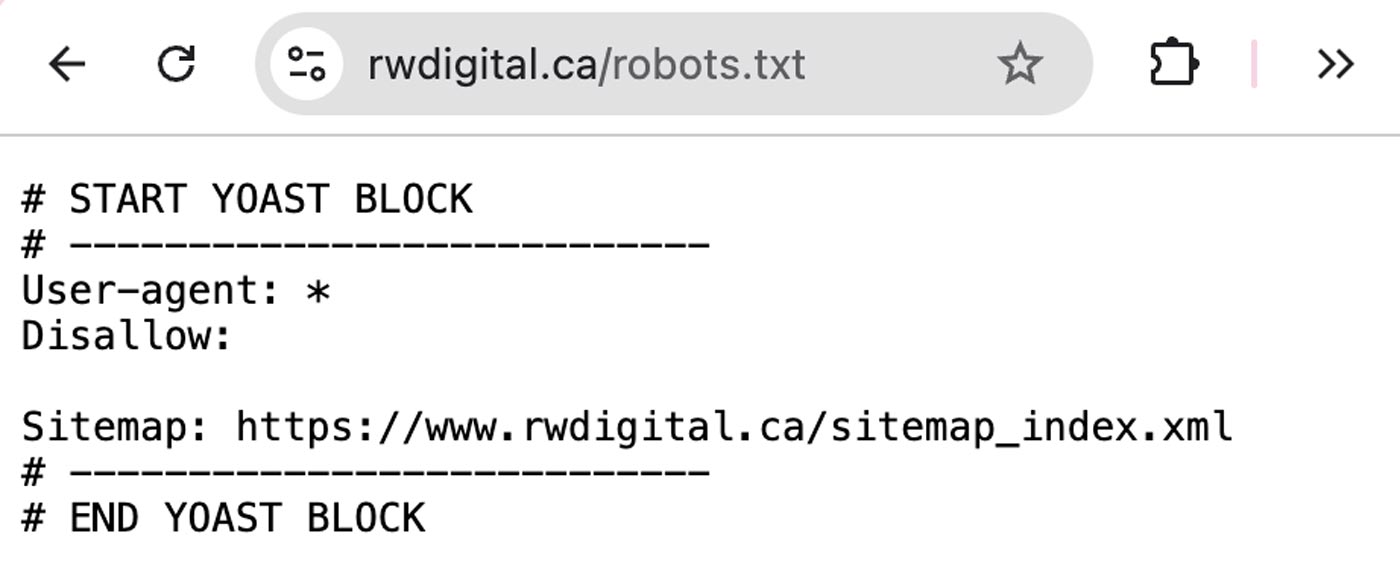
Review your website’s robots.txt file to identify any rules that may block access to important pages or resources. You can go to your website’s robots.txt file by going to domain.com/robots.txt. Example: rwdigital.ca/robots.txt.
Checklist:
- Confirm that important pages are accessible to search engine crawlers.
- Review your robots.txt file for unintended restrictions.
- Check whether important resources are blocked.
- Investigate unexpected crawling issues using Google Search Console.
For Calgary businesses investing in SEO, this is a fundamental technical check. There is little value in spending time improving a page’s content if technical settings prevent search engines from accessing it properly.
- Check Whether Your Pages Can Be Indexed
Crawling and indexing are two different things. A search engine may be able to access a page but still be instructed not to include it in its search index.
One common issue is an unintended noindex directive. This can be implemented through a meta robots tag in the HTML or an HTTP response header.
For example, a page targeting “commercial real estate lawyer Calgary” should be eligible for indexing if the goal is to attract organic search traffic.
Checklist:
- Check important pages for noindex directives.
- Review canonical tags to ensure they point to the appropriate URLs.
- Use Google Search Console’s URL Inspection tool to investigate indexing status.
- Confirm that important service pages are included in your XML sitemap where appropriate.
- Resolve unintended indexing restrictions.
AI search tools may sometimes retrieve information through sources other than a live webpage, so appearing in an AI response does not necessarily prove that a page is correctly indexed in Google. If you want to improve traditional search visibility, make sure your important pages are technically eligible for indexing.
- Make Your Content Accessible in HTML
Your important website content should be accessible as crawlable HTML rather than existing only in images, videos, or other formats that may be difficult to process.
HTML provides structure through elements such as headings, paragraphs, and lists. This helps browsers display content and gives search engines information about how a page is organized.
For example, a Calgary accounting firm could explain its corporate tax services using descriptive headings and paragraphs instead of placing all its information inside a single image.
Checklist:
- Ensure important text is available in the rendered webpage.
- Use appropriate HTML heading and paragraph elements.
- Avoid placing essential service information exclusively in images.
- Check that important content is accessible without unnecessary interactions.
- Test pages that rely heavily on JavaScript to confirm their content is rendered correctly.
Making your content accessible in HTML is a sensible foundation for search visibility. However, HTML alone does not guarantee rankings or AI citations; relevance, quality, accessibility, and other factors also matter.
- Review Page Speed Without Overlooking More Important Issues
Page speed contributes to the user experience, particularly when visitors access your website on mobile devices.
Google’s PageSpeed Insights can help identify performance issues and opportunities to improve Core Web Vitals. These measurements include loading performance, responsiveness, and visual stability.
However, businesses should prioritize improvements based on their likely impact rather than trying to achieve a perfect performance score at any cost.
Checklist:
- Test important landing pages using Google PageSpeed Insights.
- Review mobile and desktop performance.
- Identify oversized images and unnecessary scripts.
- Investigate slow server responses.
- Address significant Core Web Vitals problems.
- Prioritize improvements that make the website meaningfully faster and easier to use.
For example, if your Calgary business already has reasonable loading performance but receives few enquiries, rewriting an ineffective service page or fixing a broken contact form may offer a more immediate business benefit than making minor speed improvements.
- Match the Page to the Searcher’s Intent
One of the most important parts of on-page SEO is ensuring that a webpage satisfies the reason someone performed a search.
Consider a person searching for “emergency plumber Calgary.” They likely want to find a plumber who can respond to their problem, understand the service offered, and contact the business quickly.
A long educational article about the history of plumbing would not adequately meet that need, even if it mentioned the target keyword several times.
Different pages serve different purposes. A commercial landing page should help visitors evaluate a service and take action, while an informational article should answer a question or explain a topic.
Checklist:
- Identify what the searcher wants to accomplish.
- Review the types of pages ranking for your target query.
- Match the page format and content to that intent.
- Provide the information visitors need to make a decision.
- Make the next step clear and easy to complete.
For Calgary businesses, this is particularly important for service pages targeting local, high-intent searches. A visitor looking for a lawyer, contractor, or digital marketing agency should quickly understand whether the business offers the service they need.
- Make Your Pages Relevant to Calgary
Local relevance helps visitors understand whether your business serves their location.
If your business targets Calgary customers, your relevant service pages should clearly communicate the location and services being offered. Mentioning Calgary only in the footer or contact page may not provide sufficient context for someone landing directly on a service page.
For example, a page targeting “heating repair Calgary” should make it clear that the business provides heating repair services in Calgary.
Checklist:
- Identify the primary service and location targeted by the page.
- Include relevant location information in the title tag and main heading where appropriate.
- Explain the geographic areas you serve.
- Reference Calgary neighbourhoods when they are genuinely relevant.
- Provide locally relevant examples or details where useful.
- Avoid publishing multiple pages with nearly identical content simply to target different locations.
A business serving Calgary, Airdrie, and Cochrane may benefit from separate location pages if each one provides useful, accurate information about the services available in that area.
The objective is not to insert as many city names as possible. It is to make the page’s geographic relevance clear to both potential customers and search engines.
- Place Your Target Keyword in Important On-Page Elements
Once you have established the page’s purpose and location, review how its main topic is communicated.
Important places to consider include the URL, title tag, meta description, H1 heading, opening paragraph, and relevant H2 headings.
For example, a Calgary business targeting “commercial cleaning Calgary” might use the following structure:
- URL: /commercial-cleaning-calgary/
- Title tag: Commercial Cleaning Calgary | Company Name
- H1: Commercial Cleaning Services in Calgary
- Opening paragraph: Explain the company’s commercial cleaning services and the types of Calgary businesses it serves.
- H2: Commercial Cleaning Services for Calgary Businesses
The keyword should fit naturally into the content. Avoid repeating it unnecessarily or forcing awkward wording into headings and paragraphs.
Checklist:
- Include the main topic in the title tag.
- Use a descriptive URL.
- Write a relevant meta description.
- Include the primary topic in the H1 heading.
- Introduce the service or subject near the beginning of the content.
- Use relevant variations in H2 headings where appropriate.
- Ensure each element accurately reflects the page.
These elements help communicate what a page is about, but they should not be treated as a formula that guarantees a ranking. The overall quality, relevance, and usefulness of the page remain important.
- Make Your Content Distinctive
Your webpage should offer more than generic information that visitors can find on dozens of competing websites.
For commercial pages, this is an opportunity to explain what makes your business different. Calgary companies can demonstrate their value through their experience, service approach, customer testimonials, case studies, qualifications, and other verifiable details.
For example, a Calgary digital marketing agency could explain how it approaches GA4 consultation, Google Ads management, conversion tracking, and reporting. Specific examples of its work would provide more context than a generic statement about delivering effective digital marketing solutions.
Checklist:
- Explain your unique selling propositions.
- Include genuine customer testimonials or reviews where appropriate.
- Provide relevant case studies and examples.
- Demonstrate your experience and expertise.
- Explain your process and what customers can expect.
- Remove generic or repetitive statements that add little value.
Content uniqueness does not simply mean using different words from competing websites. It means providing information, evidence, or perspectives that make the page meaningfully useful and distinctive.
AI-generated content can be useful during research and drafting, but the final result should accurately reflect the business. Publishing generic AI-generated copy without adding relevant knowledge or evidence is unlikely to create a compelling reason for customers to choose your company.
- Make It Easy for Visitors to Contact Your Business
An important part of on-page SEO is ensuring that visitors can complete the action the page is intended to encourage.
If someone searches for a Calgary plumber and lands on a service page, they should be able to call the company or submit an enquiry without unnecessary friction.
Checklist:
- Display a clear phone number or contact option.
- Make phone numbers clickable on mobile devices.
- Test contact forms and quote-request forms.
- Confirm that submissions reach the appropriate team.
- Use clear labels and confirmation messages.
- Remove unnecessary form fields.
- Test forms for spam and invalid submissions.
Do not assume that a form works simply because it appears on the page. Submit test enquiries and verify that the information reaches the right destination.
It is also important to review lead quality. An increase in form submissions does not necessarily mean an increase in qualified leads if many submissions are spam, duplicates, or irrelevant enquiries.
- Track Whether Your Pages Generate Results
Higher rankings and more organic traffic are useful, but they are not the ultimate business objective for most Calgary companies.
A service page should ideally contribute to meaningful outcomes, such as phone calls, quote requests, appointment bookings, or sales.
Google Analytics 4 (GA4) can help you measure how visitors interact with your website and whether organic landing pages contribute to conversions.
Checklist:
- Track important form submissions.
- Measure relevant phone-call interactions.
- Configure meaningful conversion events in GA4.
- Confirm that tracking fires correctly.
- Review organic landing-page performance.
- Evaluate lead quality alongside conversion volume.
- Identify pages that attract traffic but generate few enquiries.
For example, if a Calgary service page receives organic traffic but generates very few leads, review whether its content matches search intent, whether the offer is clear, and whether the contact process works properly.
Accurate conversion tracking helps you distinguish between website activity and results that matter to the business.
- Support Your On-Page SEO With an Ongoing Review Process
On-page SEO requires ongoing attention as your services, website, competitors, and search behaviour change.
Regular reviews can help identify pages that are losing visibility, failing to attract clicks, or not converting visitors into customers.
Tools such as Google Search Console, GA4, PageSpeed Insights, and website crawling software can help you identify opportunities.
Checklist:
- Review organic search performance in Google Search Console.
- Identify important pages with declining clicks or impressions.
- Investigate queries that generate impressions but few clicks.
- Review landing-page traffic and conversions in GA4.
- Check for broken links and technical indexing issues.
- Update outdated service information.
- Prioritize improvements according to business impact.
Rather than making random changes across your entire website, start with important service pages that have clear commercial value. Fix technical issues first, then review relevance, content quality, page design, and conversion performance.
An effective on-page SEO strategy goes beyond placing keywords in the right locations. Your webpages need to be accessible to search engines, relevant to the searcher’s intent, specific to your services and locations, and useful to potential customers.
These practices can also support AI search visibility by making your website content easier to access and understand. However, neither traditional rankings nor AI citations can be guaranteed through an on-page checklist alone.
For Calgary businesses, the best starting point is to review your most important service pages and identify the changes most likely to improve search visibility and generate qualified leads.
Need help improving your website’s SEO?
RW Digital helps businesses improve organic search visibility through SEO, analytics, conversion tracking, and ongoing digital marketing support. Contact RW Digital to discuss how your website can better attract and convert potential customers in Calgary.